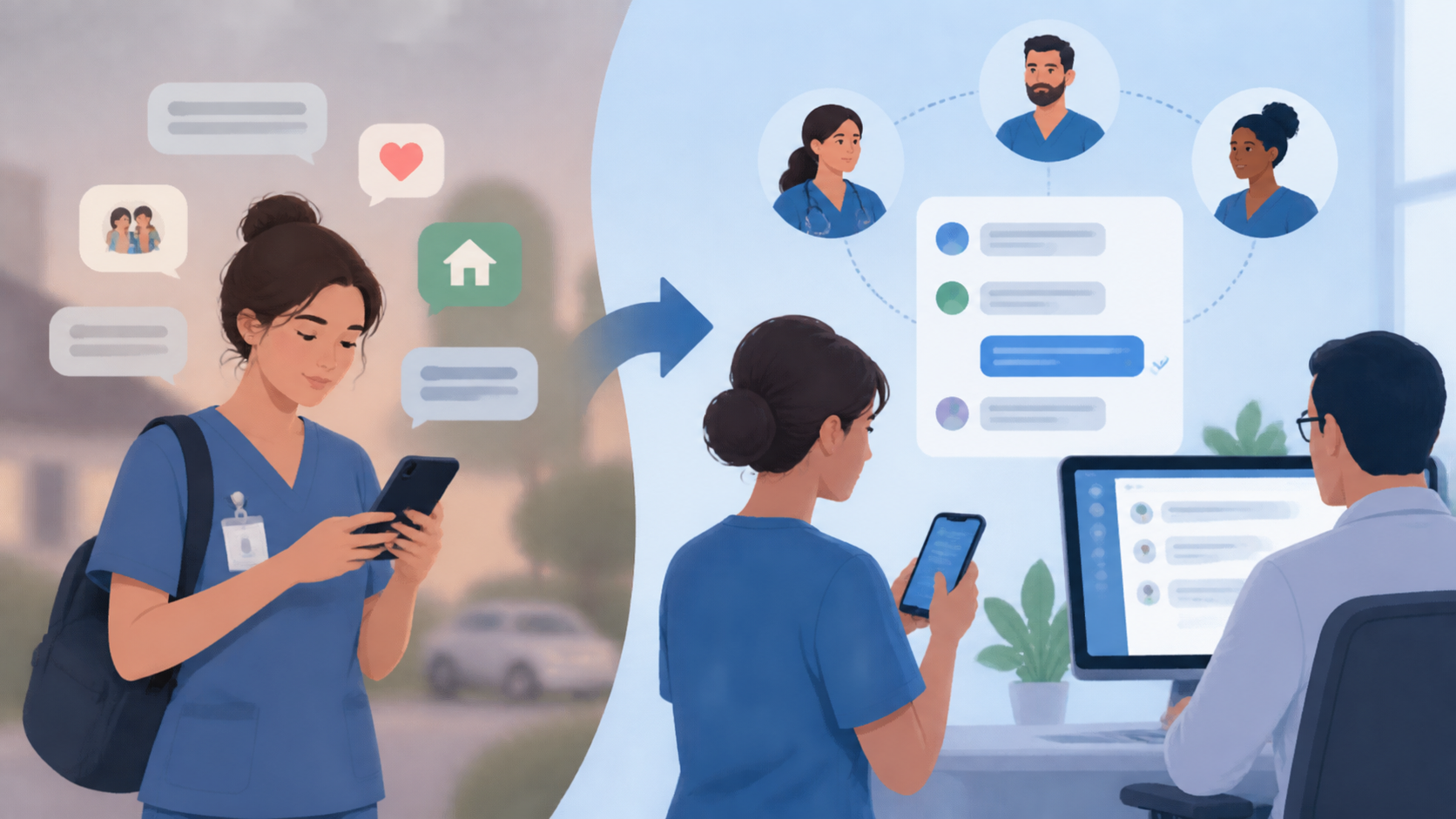
Yes, regular texting can be appropriate for simple, non-sensitive coordination with home health clinicians, provided it fits your agency’s communication policies. SMS and iMessage are familiar and convenient, but a dedicated work messenger becomes more useful when the office needs shared visibility, centrally managed users, and a clearer boundary between work and personal conversations.
Where ordinary texting works well
Texting is easy to start using: clinicians already know how it works, and there is no separate app to introduce. For an occasional message such as “Please call the office when you’re available,” that convenience can be valuable.
The limitations become more noticeable when texting becomes the main channel for daily operations. The issue is not simply whether a message reaches someone’s phone. It is whether the right people can follow the conversation, confirm responsibility, and keep communication organized when office coverage changes.
Where SMS and iMessage become harder to manage
- Work and personal conversations share the same space. Office requests sit alongside family messages, and employees may need to share personal phone numbers. A separate work app creates a clearer boundary, although after-hours expectations still need to be defined.
- Office visibility depends on who received the text. If a clinician messages one scheduler directly, a covering colleague may not see the exchange. Forwarding messages or asking for screenshots adds work and can leave gaps.
- Membership is managed conversation by conversation. Personal texting does not give the agency a central system for managing work accounts and permissions. Staff changes can require updating multiple groups.
- Read status is inconsistent. Ordinary SMS does not provide read receipts. iMessage can show them when enabled, but availability depends on the messaging method and settings. A read indicator also does not mean someone has accepted or completed a task.
- Group threads can become difficult to follow. Coverage requests, scheduling questions, and general announcements may end up mixed together, especially when several overlapping groups exist.
For example, if a clinician sends an availability update only to the morning scheduler, the afternoon scheduler may have to reconstruct the exchange. A designated work group that includes the appropriate office staff can make that handoff easier.
When a dedicated work messenger becomes useful
Consider a separate messaging app when missed handoffs, repeated follow-ups, or scattered group texts become recurring problems. Look for centrally managed accounts, organized group conversations, read status, and access from both clinicians’ phones and office computers.
Brosix is one option for creating that separate business communication space. It provides a closed network for authorized users, centrally managed accounts and contact lists, one-to-one and group chats, chat rooms, and read receipts with SEEN status. Clinicians can use its iOS or Android apps while office staff use desktop apps or the web version.
Shared visibility still requires intentional setup. Choose which conversations belong in an office-and-clinician group rather than a private message. A business messenger should not be assumed to make every private conversation visible to every manager.
The tradeoff is another app to introduce and maintain. Its value depends on staff consistently using it, rather than splitting the same conversation between personal texts and work chat.
Set communication rules before switching
Define which channel handles routine coordination, who monitors each group, and when an explicit acknowledgment is required. For urgent matters, establish a call or escalation process instead of relying solely on a read receipt.
Separately review your agency’s requirements for patient information; moving to a business app alone does not settle those requirements. If texting still handles occasional logistical messages well, it may remain useful. If daily coordination depends on finding conversations across individual phones, a managed work messaging space is worth evaluating.